{"time":1773405813129,"blocks":[{"type":"paragraph","data":{"text":"Há muita literatura sobre a história do Rio de Janeiro. "}},{"type":"paragraph","data":{"text":"Aqui, tentamos enxergar tudo através do estômago.
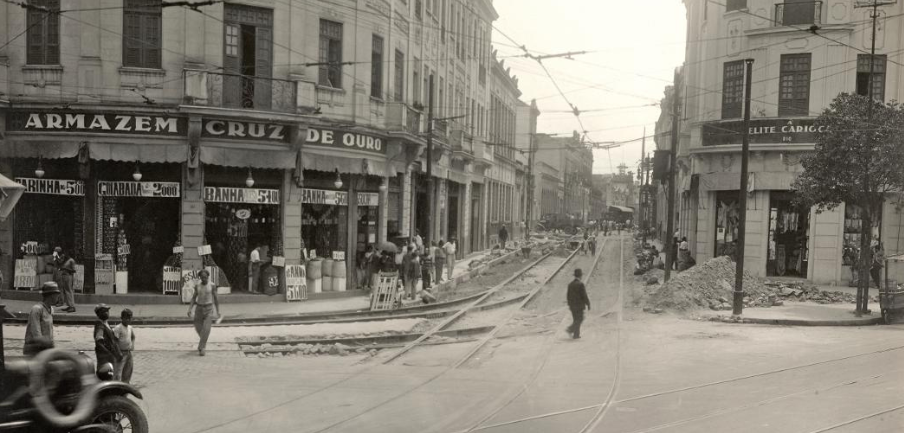
"}},{"type":"paragraph","data":{"text":"Espremida entre dois morros que foram postos abaixo – o do Senado e o de Santo Antônio – a Rua do Senado sofreu, por muitos anos, as consequências dos arrasamentos. "}},{"type":"paragraph","data":{"text":"Graças à poeira e ao caos que se seguiram, sua presença nos jornais de época era frequente, mas quase sempre na seção de queixas da população, que convivia com a lama, a escuridão e o mau cheiro, ou protestava contra “ladrões e gravateiros” que se escondiam nos destroços da derrubada. "}},{"type":"paragraph","data":{"text":"N’O Volantim, publicação de 21 de agosto de 1823, enquanto a rua ainda tomava o apelido de Beco da Caçoada (ou Cassuada), um cidadão afirma que era “quase intransitável” e que havia “lama, entulho, rãs, sapos, pererecas”. Um outro jornal, arremata: “onde foram demolidas várias casas, cujos destroços servem de esconderijo a ladrões e gravateiros”. E no meio disso tudo, a sede da Câmara Municipal."}},{"type":"Image","data":{"file":{"name":"image.png","url":"https://django-instituto-bazzar.s3.amazonaws.com/media/image_RnQxzOf.png"},"caption":"Chalhoub 1996","withBorder":false,"stretched":false,"withBackground":false}},{"type":"paragraph","data":{"text":"Naquela rua, havia uns trechos melhores e piores, mas até o fim do século XIX, funcionava mais como local de conveniência para quem vivia ali, do que com algum protagonismo. A imensa maioria dos moradores era de funcionários públicos, além de guarda-livros, tipógrafos, sapateiros, pintores, operários e, ocasionalmente, médicos ou procuradores. "}},{"type":"paragraph","data":{"text":"Era uma rua de retaguarda, com depósitos de cereais; algumas padarias que também supriam outros restaurantes; gente que fazia “empadas, sequilhos e marmeladas, branca ou vermelha” sob encomenda; fábricas de cerveja: hotéis sem vocação turística: umas poucas casas de pasto e botequins. "}},{"type":"paragraph","data":{"text":"Como não era hábito haver anúncios em jornais ou cardápios em restaurantes mais simples, além dos “cantados” diretamente ao freguês, há pouca pista sobre o que serviam. "}},{"type":"paragraph","data":{"text":"A chegada da Família Real trouxe vida cultural e uma profusão de teatros e casas de shows que se estabeleceram na Rua do Lavradio e em torno da Praça Tiradentes. E a vida da Rua do Senado e arredores ficou tão interconectada aos espetáculos, que vários pratos, restaurantes e bares foram batizados com o nome de peças ou atores. "}},{"type":"paragraph","data":{"text":"Na Rua Espírito Santo – atual Pedro I, que liga a Rua do Senado à Praça Tiradentes – o restaurante Maison Moderne, em 1886, trazia no cardápio um filé com o nome da atriz francesa Sarah Bernhardt, considerada uma das atrizes mais famosas de todos os tempos, depois de sua turnê pelo Rio de Janeiro."}},{"type":"Image","data":{"file":{"name":"image.png","url":"https://django-instituto-bazzar.s3.amazonaws.com/media/image_MbotLWA.png"},"caption":"“O Programma- Avisador”, 4 de junho de 1886","withBorder":false,"stretched":false,"withBackground":false}},{"type":"paragraph","data":{"text":"No número 76 da Rua do Lavradio, entre as atuais Senado e Relação, o restaurante Éden, que também aceitava pensionistas, foi batizado em homenagem ao Theatro Éden-Lavradio, no n.96. Na publicação em francês chamada Étoile do Sud, naturalmente dirigida a estrangeiros, o Éden-Restaurant foi bastante anunciado ao longo do ano de 1895 como um dos estabelecimentos recomendados da cidade. "}},{"type":"Image","data":{"file":{"name":"image.png","url":"https://django-instituto-bazzar.s3.amazonaws.com/media/image_SwpzZe6.png"},"caption":"“Étoile du Sud” (publicação para estrangeiros no Rio), 22 de junho de 1895","withBorder":false,"stretched":false,"withBackground":false}},{"type":"paragraph","data":{"text":"O maior rastro documental da gastronomia da Rua do Senado, no entanto, começa a partir de 1906, depois dos dois aterramentos, num terreno já plano que permitiu que florescesse. "}},{"type":"paragraph","data":{"text":"Logo depois do desmonte do Morro, em 1907, surge o “Armazém Senado”, que segue firme com seus 115 anos de existência. No cardápio da época: sardinha frita, bolinhos de bacalhau e um curioso tira-gosto chamado \"mec-mec\" ou “sacanagem”. Servido no palito, vinha com provolone, tomate, cebola, salaminho e pimentão. "}},{"type":"paragraph","data":{"text":"A partir dessa data, surgem as belas fachadas históricas que vemos, ainda hoje, e notamos uma quantidade crescente de botequins, padarias, casas de pasto (as precursoras dos restaurantes), cafés, secos e molhados, hotéis e açougues, ali listados. E, agora, para além das fábricas de cervejas, depósitos de café."}},{"type":"paragraph","data":{"text":"A região da Praça Tiradentes fica ainda mais rica em teatros, lá para o início do século XX, e três deles ficavam na Rua do Lavradio. Da necessidade de comer ou beber algo, antes ou depois dos shows, é que atores, cenógrafos, redatores e outros, emprestaram à Rua do Senado os primeiros contornos de boemia."}},{"type":"Image","data":{"file":{"name":"image.png","url":"https://django-instituto-bazzar.s3.amazonaws.com/media/image_osB9Euo.png"},"caption":"","withBorder":false,"stretched":false,"withBackground":false}},{"type":"paragraph","data":{"text":"Quando lembramos que o horário de jantar no fim do século XIX se dava em torno de 16hs, e o da ceia, às 18hs, chama atenção que os estabelecimentos da Rua do Senado ficassem abertos “até 1 hora da noite”, como era o caso da Tim-Tim por Tim-Tim, uma ‘casa de petisqueiras’ na esquina de Lavradio com Senado, e um dos restaurantes mais longevos da área, inaugurado em 1888. "}},{"type":"paragraph","data":{"text":"As petisqueiras eram casas simples, em geral de comerciantes portugueses, que tinham cardápio cantado pelos garçons. Serviam pratos como peixadas, bacalhoadas, papas à portuguesa (a precursora da nossa batata portuguesa), leitõezinhos dourados, tripas e feijoadas completas. Os funcionários, em geral, faziam o serviço em “mangas de camisa”, enquanto nos restaurantes, os usavam uniformes ou jaquetas brancas de linho. "}},{"type":"Image","data":{"file":{"name":"image.png","url":"https://django-instituto-bazzar.s3.amazonaws.com/media/image_kmSAUdP.png"},"caption":"","withBorder":false,"stretched":false,"withBackground":false}},{"type":"Image","data":{"file":{"name":"image.png","url":"https://django-instituto-bazzar.s3.amazonaws.com/media/image_oOJV4oq.png"},"caption":"“Diário da Noite”, 16 de setembro de 1958","withBorder":false,"stretched":false,"withBackground":false}},{"type":"paragraph","data":{"text":"O Tim-Tim por Tim-Tim funcionou até 1967 com uma clientela célebre, que incluiu Sarah Bernardt e sua contemporânea, a comediante francesa Réjane; diplomatas, Paulinho da Viola, que frequentava a casa nos anos 60, ou ainda o ex-presidente José Sarney que, em entrevista a Ancelmo Gois, em dezembro de 2008, cita o Tim-Tim como um dos preferidos da sua juventude. Seu cardápio de almoço e jantar era publicado, com bastante frequência, no jornal A Época, entre os anos de 1917 e 1918:"}},{"type":"Image","data":{"file":{"name":"image.png","url":"https://django-instituto-bazzar.s3.amazonaws.com/media/image_Uf3kki5.png"},"caption":"“A Época” , 15 de outubro de 1917.","withBorder":false,"stretched":false,"withBackground":false}},{"type":"paragraph","data":{"text":" Já a Garoto do Senado, casa inaugurada em 1922 na rua Carlos Sampaio, esquina com Senado, tinha como especialidades as pescadas, peixadas à portuguesa, ostras, camarões e canjas. "}},{"type":"paragraph","data":{"text":"Seus anúncios traziam pratos portugueses tradicionais, “Hoje! Hoje! Sarrabulho à portuguesa” ou “tripas à moda do Porto”, mas também, comidas popularizadas pelos africanos escravizados, como “vatapá” ou o popularíssimo “zoró de camarão”, prato de camarões secos com quiabos e ‘mulato velho’ (o bagre salgado e defumado). "}},{"type":"paragraph","data":{"text":"Nos copos, “Vinho verde diretamente recebido de Cabeceira de Bastos. Pode garantir que não há melhor no Rio de Janeiro! O Garoto do Senado avisa aos apreciadores do bom vinho que não deixem de experimentar”. "}},{"type":"paragraph","data":{"text":"No romance de João do Rio, Armando dá pistas do que se poderia comer num frege da Rua Espírito Santo, “devorou o caldo verde com grossos pedaços de pão, devorou o bife, sorveu meia garrafa de vinho, mastigou duas bananas”. Era assim."}},{"type":"paragraph","data":{"text":"Numa coluna de 1931, Ruben Gill, do Diário da Noite, faz “entrevistas oportunas sobre os problemas momentosos da vida carioca”. Em conversa com Manoel Rocha, ex-ator e proprietário da casa de petisqueiras “O Solar dos Barrigas”, entendemos que a casa tinha gabinetes reservados e, também, reconstituía o cenário da opereta homônima. De acordo com Gill, Sr. Manoel conseguia fazer esgotar todas as noites, as lotações e os pratos de sua casa na Rua do Senado, onde “noceurs de bom gosto” se reuniam para saborear as criações típicas da culinária lusitana. O jornalista pergunta com estranheza, que utilidade as instalações telefônicas tinham numa casa tão atraente, ao que Sr. Manoel responde:"}},{"type":"paragraph","data":{"text":"- “Ah, o telefone? É a melhor invenção do mundo gastronômico! Tenho a impressão de que os aparelhos telefônicos foram inventados para toda gente encomendar-me “iscas” e assegurar mesas para os almoços, os jantares e as ceias!”. Era o prenúncio do que estava por vir."}},{"type":"paragraph","data":{"text":"Mais adiante, na história, outro depoimento reforça a conexão entre a Rua do Senado e os teatros:"}},{"type":"paragraph","data":{"text":"“Eu vivi em muitas casas na Praça Tiradentes e nas imediações: Pedro I, Rua do Senado, Rua do Lavradio, Gomes Freire. (...) Saía pela manhã, almoçava na rua. À noite, saía do teatro e jantava, também por ali. A moradia dava direito a chuveiro, e se a família fosse camarada, a gente podia usar o fogão uma vez ou outra” – nos conta Dercy Gonçalves, a jovem vedete dos anos 40 no livro “Dercy: de cabo a rabo”, sua autobiografia assinada por Maria Adelaide Amaral."}},{"type":"paragraph","data":{"text":"E viva a nossa vedete, símbolo de irreverência e liberdade feminina!"}},{"type":"paragraph","data":{"text":"Outro ícone carioca também faz história, desde 1965. Naquele ano, o sobrado da antiga padaria de Pietro Mandarino, na Rua do Senado, 273, foi comprado pelos donos da Padaria Globo, em Botafogo, e ali passou a ser - e é até hoje - a fábrica de um produto que é a cara do Rio: o Biscoito Globo."}},{"type":"paragraph","data":{"text":"
Finalmente, depois de tanta história, chegamos à conclusão de que UM PRATO foi comum a todos os restaurantes, freges, petisqueiras e casas de pasto da rua: a CANJA. De longe, o maior símbolo de boemia, era servida a partir das dez da noite e alimentava artistas e convidados que deixavam os espetáculos arados de fome. "}},{"type":"paragraph","data":{"text":"Pedro II (1825-1891) talvez tenha sido o responsável pela moda. Tinha o hábito de tomar uma canja entre o segundo e o terceiro atos de uma peça, e só depois de avisarem que havia terminado, seguia o show. "}},{"type":"Image","data":{"file":{"name":"image.png","url":"https://django-instituto-bazzar.s3.amazonaws.com/media/image_qgNSt0K.png"},"caption":"“Gazeta da Tarde”, 27 de abril de 1896","withBorder":false,"stretched":false,"withBackground":false}},{"type":"paragraph","data":{"text":" Símbolo da vida dos artistas e de quem caminhava pela madrugada, era o prato de eleição na região, após o espetáculo, e acabou ganhando o apelido de ‘canja da meia noite’. "}},{"type":"paragraph","data":{"text":"“Dar uma canja”, enfim, é prática associada ao mundo artístico, às performances improvisadas que aconteceram tantas vezes em botequins, restaurantes e petisqueiras, num Rio que quase esquecemos. "}},{"type":"Image","data":{"file":{"name":"image.png","url":"https://django-instituto-bazzar.s3.amazonaws.com/media/image_DeOp4p2.png"},"caption":"“Il Pasquino Coloniale” (jornal de São Paulo citando o estabelecimento no Rio), outubro de 1937","withBorder":false,"stretched":false,"withBackground":false}}],"version":"2.18.0"}
Voltar
Go back
TerritóriosPublicado em
Published in
2 de Julho de 2024 às 16:13
Tempo de leitura
Reading time
7 Minutos
7 Minutes
Compartilhe
Share
{"time":1773405675060,"blocks":[{"type":"paragraph","data":{"text":"There is a lot of literature on the history of Rio de Janeiro. "}},{"type":"paragraph","data":{"text":"Here, we try to see everything through the stomach."}},{"type":"paragraph","data":{"text":"Squeezed between the two hills of Senado and Santo Antônio, which had been demolished, Rua do Senado suffered the consequences of the devastation for many years."}},{"type":"paragraph","data":{"text":"Thanks to the dust and chaos that ensued, its presence in the newspapers of the time was frequent, but almost always in the complaints section of the population, who lived with the mud, darkness and foul smell, or in the protests against the \"thieves and thugs\" who were hiding in the debris of the demolition."}},{"type":"paragraph","data":{"text":"In O Volantim, publication of August 21, 1823, while the street was still called Beco da Caçoada (or Cassuada), a citizen states that it was \"almost impassable\" and that there was \"mud, rubble, frogs, and toads\" Another newspaper states: \"where several houses were demolished remains a hiding place for thieves and thugs\". And in the middle of it all, the headquarters of the City Council."}},{"type":"Image","data":{"file":{"name":"image.png","url":"https://django-instituto-bazzar.s3.amazonaws.com/media/image_4skW5DP.png"},"caption":"Chalhoub 1996","withBorder":false,"stretched":false,"withBackground":false}},{"type":"paragraph","data":{"text":"There were better and worse sections of the street, but until the end of the 19th century, it functioned more as a place of convenience for those who lived there, rather than as a place of protagonism. The vast majority of residents were civil servants, as well as bookkeepers, printers, shoemakers, painters, workers and, occasionally, doctors or attorneys."}},{"type":"paragraph","data":{"text":"It was a back street, with grain stores; some bakeries that also supplied other restaurants; people who made \"savories, biscuits and marmalades, white or red\" to order; beer factories; non-tourist hotels; a few eating establishments and taverns."}},{"type":"paragraph","data":{"text":"As it was not customary to advertise in newspapers or to have menus in simpler restaurants—apart from those \"sung\" directly to the customer—there is little clue as to what they served."}},{"type":"paragraph","data":{"text":"The arrival of the Royal Family brought cultural life and a profusion of theaters and concert halls that were established on Rua do Lavradio and around Praça Tiradentes. And the life of Rua do Senado and its surroundings became so interconnected with the shows that several dishes, restaurants, and bars were named after plays or actors."}},{"type":"paragraph","data":{"text":"On Rua Espírito Santo — now Pedro I, which connects Rua do Senado to Praça Tiradentes — the Maison Moderne restaurant, in 1886, featured a steak on the menu named after the French actress Sarah Bernhardt, considered one of the most famous actresses of all time after her tournée in Rio de Janeiro."}},{"type":"Image","data":{"file":{"name":"image.png","url":"https://django-instituto-bazzar.s3.amazonaws.com/media/image_7a7gGC7.png"},"caption":"O Programma-Avisador, 4 de junho de 1886","withBorder":false,"stretched":false,"withBackground":false}},{"type":"paragraph","data":{"text":"At number 76 on Rua do Lavradio, between the current Senado and Relação, the Éden restaurant, which also accepted pensioners, was named in honor of Theatro Éden-Lavradio, at n.96. In the French publication Étoile do Sud, naturally aimed at foreigners, the Éden-Restaurant was widely advertised i the first fa half of 1895, as one of the most recommended establishments in the city."}},{"type":"Image","data":{"file":{"name":"image.png","url":"https://django-instituto-bazzar.s3.amazonaws.com/media/image_2rs7wGD.png"},"caption":"“Étoile du Sud” (publication for foreigners in Rio), June 22, 1895","withBorder":false,"stretched":false,"withBackground":false}},{"type":"paragraph","data":{"text":"The largest documented trail of the gastronomy of Rua do Senado, however, begins in 1906, after the two landfills and on the already flat land that allowed it to flourish."}},{"type":"paragraph","data":{"text":"Soon after the dismantling of the hill in 1907, the \"Armazém Senado\" was established, which is 115 years old today. On the menu at the time: fried sardines, cod fritters and a curious snack called mec-mec or sacanagem—provolone, tomato, onion, salami, and peppers on a skewer."}},{"type":"paragraph","data":{"text":"From that date onwards, the beautiful historical facades that we still see today appeared, together with an increasing number of taverns, bakeries, eating houses (the precursors of restaurants), cafes, dry goods, hotels and butchers, in addition to the more recent beer factories and coffee warehouses."}},{"type":"paragraph","data":{"text":"The Praça Tiradentes region became even richer in theaters at the beginning of the 20th century, and three of them were on Rua do Lavradio. The need to eat or drink something before or after the shows is why actors, set designers, editors and others gave Rua do Senado its first bohemian contours."}},{"type":"Image","data":{"file":{"name":"image.png","url":"https://django-instituto-bazzar.s3.amazonaws.com/media/image_hob8LzY.png"},"caption":"Jornal das Moças, maio de 1921","withBorder":false,"stretched":false,"withBackground":false}},{"type":"paragraph","data":{"text":"When we remember that dinner time at the end of the 19th century was around 4 pm, and supper time at 6 pm, it is noteworthy that the establishments on Rua do Senado were open \"until 1 o'clock at night\", as in the case of Tim-Tim por Tim-Tim, a petisqueira, or snack bar, on the corner of Lavradio and Senado, and one of the oldest restaurants in the area, opened in 1888."}},{"type":"paragraph","data":{"text":"Petisqueiras were simple houses, generally owned by Portuguese traders, with a menu ‘sung’ by waiters. They served dishes such as fish, cod, Portuguese-style potatoes, roast suckling pig, tripe and feijoadas. Employees, in general, performed the service in \"shirt sleeves\", while in restaurants, they wore uniforms or white linen jackets."}},{"type":"Image","data":{"file":{"name":"image.png","url":"https://django-instituto-bazzar.s3.amazonaws.com/media/image_V1YKti3.png"},"caption":"“A Noite Ilustrada”, novembro de 1932","withBorder":false,"stretched":false,"withBackground":false}},{"type":"Image","data":{"file":{"name":"image.png","url":"https://django-instituto-bazzar.s3.amazonaws.com/media/image_gCnArZB.png"},"caption":"“Diário da Noite”, 16 de setembro de 1958","withBorder":false,"stretched":false,"withBackground":false}},{"type":"paragraph","data":{"text":"Tim-Tim por Tim-Tim was open until 1967 with its celebrity\nclientele, which included Sarah Bernardt and her contemporary, the French\ncomedian Réjane; diplomats; Paulinho da Viola, a regular in the 60s; and even\nformer president José Sarney who, in an interview with Ancelmo Gois in December\n2008, cites Tim-Tim as one of his favorites from his youth. Its lunch\nand dinner menu were published quite frequently in the newspaper A Época,\nbetween 1917 and 1918:"}},{"type":"Image","data":{"file":{"name":"image.png","url":"https://django-instituto-bazzar.s3.amazonaws.com/media/image_TlB66J6.png"},"caption":"“A Época” , 15 de outubro de 1917.","withBorder":false,"stretched":false,"withBackground":false}},{"type":"paragraph","data":{"text":"Garoto do Senado opened in\n1922 on the corner of Rua Carlos Sampaio and Senado. Its specialties were fish,\noysters, shrimp, and chicken soup."}},{"type":"paragraph","data":{"text":"Their advertisements featured traditional Portuguese\ndishes, \"Today! Today! Sarrabulho à portuguesa\" or \"Porto-style\ntripe\", but also foods popularized by enslaved Africans, such as vatapá\nor the very popular zoró, a shrimp dish dried with okra and old mulato\n(salted and smoked catfish)."}},{"type":"paragraph","data":{"text":"In the glasses, \"Vinho verde direct from Cabeceira\nde Bastos. You can guarantee that there is no better one in Rio de Janeiro!\nGaroto do Senado advises lovers of good wine to be sure to try it.\""}},{"type":"paragraph","data":{"text":"In João do Rio's novel, Armando gives clues about what one could eat in a\nrestaurant on Rua Espírito Santo, \"he devoured the caldo verde with\nthick pieces of bread, devoured the steak, drank half a bottle of wine, chewed\ntwo bananas\". That is what it was like. "}},{"type":"paragraph","data":{"text":"In a 1931 column, Ruben Gill, from Diário da Noite, gives\n\"timely interviews on the momentous problems of Rio life\". In\nconversation with Manoel Rocha, former actor and owner of the snack bar O\nSolar dos Barrigas, we understood that the house had reserved rooms and\nalso reconstituted the scene of the operetta of the same name. According to\nGill, Mr. Manoel managed to sell out the food and dishes at his house on Rua do\nSenado every night, where \"noceurs with good taste\" gathered\nto taste typical Lusitanian cuisine. The journalist asks strangely what use\ntelephone installations had in such an attractive house, to which Mr. Manoel\nresponds:"}},{"type":"paragraph","data":{"text":" \"Ah, the telephone? It's the\nbest invention in the gastronomic world! I have the impression that telephone\ndevices were invented so that everyone could order [liver] strips from me\"\nand reserve tables for lunches, dinners, and supper!\". It was a harbinger\nof what was to come. "}},{"type":"paragraph","data":{"text":"Later in the story, another statement\nreinforces the connection between Rua do Senado and the theaters:"}},{"type":"paragraph","data":{"text":"\"I lived in many houses in Praça\nTiradentes and in the surrounding area: Pedro l, Rua do Senado, Rua do\nLavradio, Gomes Freire. (...) I would go out in the morning, have lunch on the\nstreet. In the evening, I would leave the theater and have dinner, too. The\nhouse had access to a shower, and if the family were friendly, we could use the\nstove from time to time\" said Dercy Gonçalves, the young star of the 40s\nin her book Dercy: de cabo a rabo, her autobiography signed by Maria\nAdelaide Amaral."}},{"type":"paragraph","data":{"text":"And long live our star, a symbol of\nirreverence and feminine freedom!"}},{"type":"paragraph","data":{"text":"Another Rio icon also made history: in 1965 the\nold bakery of Pietro Mandarino at Rua do Senado, 273, was purchased by the\nowners of Padaria Globo in Botafogo, where to this day it is the factory\nof the iconic product of Rio, Biscoito Globo."}},{"type":"paragraph","data":{"text":"Finally, after so much history, we concluded\nthat ONE DISH was common to all restaurants, bars, snack bars and eating\nestablishments on the street: canja. The chicken soup was by far the\ngreatest symbol of bohemians, served after ten at night, feeding artists and theatergoers\nwho left the shows hungry."}},{"type":"paragraph","data":{"text":"Pedro II (1825-1891) was perhaps responsible\nfor the fashion. He had a habit of having canja between the second and\nthird acts of a play. Only after being told that the emperor had finished would\nthe show continue."}},{"type":"Image","data":{"file":{"name":"image.png","url":"https://django-instituto-bazzar.s3.amazonaws.com/media/image_gWv4ayV.png"},"caption":"“Gazeta da Tarde”, 27 de abril de 1896","withBorder":false,"stretched":false,"withBackground":false}},{"type":"paragraph","data":{"text":"Symbol of the lives of artists and those who walked in the early hours\nof the morning, canja was the dish of choice in the neighborhood after\nthe show, and it ended up earning the nickname 'midnight soup'."}},{"type":"paragraph","data":{"text":"Dar uma\ncanja, or “serving\nup the soup”, is an expression associated with the artistic world, referring to\nimprovised performances, which were so common in the in bars, restaurants, and\nsnack bars of a Rio de Janeiro that we have almost forgotten."}},{"type":"Image","data":{"file":{"name":"image.png","url":"https://django-instituto-bazzar.s3.amazonaws.com/media/image_TXwSnYR.png"},"caption":"11 Pasquino Coloniale (newspaper from São Paulo citing the establishment in Rio), October 1937","withBorder":false,"stretched":false,"withBackground":false}}],"version":"2.18.0"}
Estamos mapeando destinos.
We are mapping out the territory.
Clique no pin pra saber mais sobre o restaurante. Começamos pelo RJ mas pretendemos explorar territórios em todo o Brasil.
Click on the pin to find out more about the restaurant. We started in RJ but we intend to explore territories throughout Brazil.